Nucleolar Droplets On Demand

Reflecting work in the Department of Synthesis of Macromolecules at the Max Planck Institute for Polymer Research

Published here August 17, 2026

Reversible Nucleolar Complex Coacervation by Short Cationic Peptides

Maximilian Schuler, Emirhan Koca, Leon Driehaus-Ortiz, Marius G. Braun, Albin Lahu, Anna-Lena Holtmannspötter, Ha-Chi Nguyen, Job Boekhoven, David Y. W. Ng, and Tanja Weil

J. Am. Chem. Soc. 2026, 148, 27528–27539. https://doi.org/10.1021/jacs.6c06046

View Original Publication


Biomolecular condensates, the membrane-less droplets that cells use to organize chemistry without enclosing it, form by liquid–liquid phase separation, LLPS, driven by multivalent weak interactions among proteins and RNA. Replicating that logic with short synthetic peptides inside living cells is conceptually attractive but practically demanding: reaching the critical concentration for LLPS typically requires local peptide levels an order of magnitude higher than those needed to seed solid aggregates, and the resulting droplets are sensitive to salt, pH, and temperature. Prior work on intracellular self-assembly had produced nanofibers and hydrogels, but crossing from liquid-to-solid into liquid-to-liquid phase transitions with minimalist synthetic inputs had not been achieved. Solving that problem would provide a platform for reversible, stimulus-responsive compartments that could be switched on and off inside living cells without permanent structural commitment.

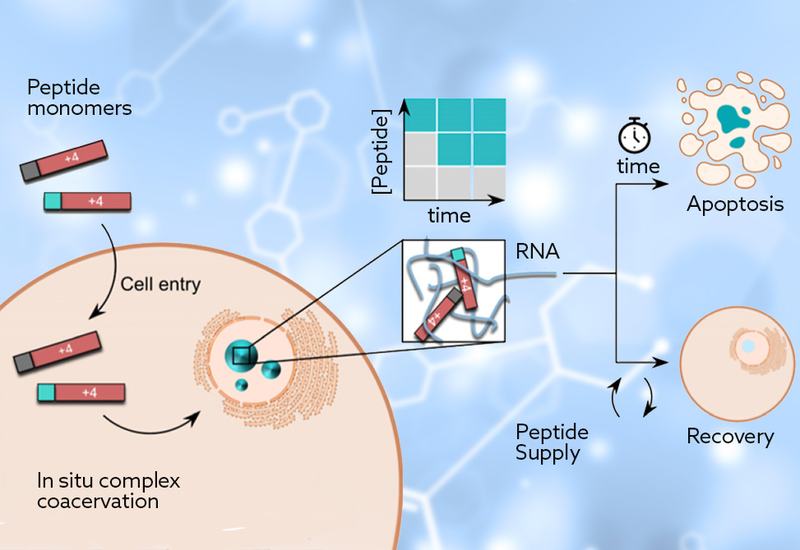
Researchers working with Tanja Weil and David Ng in the Department of Synthesis of Macromolecules at the Max Planck Institute for Polymer Research, published in J. Am. Chem. Soc., reasoned that rather than fighting the intracellular environment, a well-designed peptide could exploit it. They synthesized Fmoc-K(TPP)RGRGR-CONH2, a seven-residue cationic peptide carrying an N-terminal fluorenylmethoxycarbonyl block, three arginine residues alternating with glycines in a pattern that mimics RG motifs of natural RNA-binding proteins, and a triphenylphosphonium, TPP, side chain originally intended to direct the peptide to mitochondria. In vitro calorimetry revealed that polymeric RNA binds the peptide with a dissociation constant of 3.5 ± 0.3 μM, more than two orders of magnitude tighter than ATP, and drives coacervation at peptide concentrations 30-fold lower than ATP requires. Inside A549 human lung adenocarcinoma cells, the arginine content overrides the TPP targeting signal and steers the peptide toward the RNA-dense nucleolus, where complex coacervates nucleate within one minute. The Fmoc π-block, the number of Gly–Arg repeats, and the TPP side chain each proved essential: due to a decrease in RNA affinity as evidenced by in vitro experiments.

The most consequential feature of the system is its reversibility. Washing out the peptide triggers droplet dissolution within about sixty minutes and allows cellular viability to recover to nearly 80%, in contrast to the irreversible fiber-forming peptides that dominate the intracellular self-assembly literature. This substrate-dependent on/off behavior provides a conceptual foundation for reversible compartment engineering inside living cells, transient metabolic modulation, and the design of synthetic reaction spaces that operate in dynamic exchange with the cellular environment. The full structural requirements, kinetic data, and cell-recovery experiments are reported in the original publication.


Author

David Y. W. Ng, Ph.D., is currently Group Leader of the Synthetic Life-like Systems Group and the head of BioCore at the Max Planck Institute for Polymer Research. David pursued chemistry at the National University of Singapore with 1st class honours and moved to Germany for his doctoral studies jointly offered by the Max Planck Institute for Polymer Research, MPIP, and Ulm University under the supervision of Prof. Tanja Weil. He graduated summa cum laude in 2014 and started as a junior group leader at Ulm University. He subsequently joined the MPIP in 2016 and founded the synthetic life-like systems group to bring supramolecular concepts that modify and create new cellular functions at the systems level. Since 2021, David co-established the BioCore Facility as an integral unit within the MPIP to study complex dynamic behaviour at the material-cell interface. He is featured in journals of the German Chemical Society & the Royal Society of Chemistry as an emerging key figure for material science at the chemistry-biology interface.

Author

Prof. Dr. Tanja Weil is a Director at the Max Planck Institute for Polymer Research in Mainz, where she heads the Department of Synthesis of Macromolecules. She studied chemistry at TU Braunschweig and the University of Bordeaux I and received her Ph.D. from the Max Planck Institute for Polymer Research. Following leading positions in medicinal chemistry and chemical R&D at Merz Pharmaceuticals, she joined the National University of Singapore and later became Director of the Institute of Organic Chemistry III at Ulm University. Her research bridges macromolecular and supramolecular chemistry with biology to create programmable, self-assembling and biohybrid materials that interface with living systems and control cellular function. Her distinctions include the Karl Ziegler Prize, the Netherlands Scholar Award for Supramolecular Chemistry, an ERC Synergy Grant, and the Otto Hahn Medal of the Max Planck Society. She has served on major scientific advisory and steering bodies, including the Senates of the German Research Foundation and the Leibniz Association, and is an Associate Editor of the Journal of the American Chemical Society.

Nucleolar Droplets On Demand

Author

Maximilian Schuler, M.Sc., earned his B.Sc. in Molecular Biology and Biology from Johannes Gutenberg University Mainz before joining the Matter to Life program as a scholar in 2020. He subsequently received his M.Sc. from Heidelberg University in 2022. For his master’s thesis, conducted under the supervision of Prof. Dr. Tanja Weil, he investigated the assembly of stimulus-responsive boronic acid peptides and their potential applications in biomedicine. Within the same research group, Maximilian is currently pursuing his Ph.D. at the Max Planck Institute for Polymer Research. His research focuses on the design of supramolecular peptide-based catalysts and the interface between biology and synthetic systems, with the aim of developing functional materials that exhibit emergent, “life-like” properties. During his Ph.D., he has contributed as a co-author to five peer-reviewed scientific publications.